Sidewalk Knows More About Accessibility Than Your Website

Some of the best ideas in society begin as solutions for a few people and end up improving life for everyone. The curb cut is a perfect example.
We’ve seen it countless times, the small ramp connecting a sidewalk to the street. Today, it feels so ordinary that most of us barely notice it. Yet behind that simple slope lies one of the most powerful lessons in design: when we remove barriers for those who need support the most, everyone benefits. This principle is known as the Curb-Cut Effect.
It originated in Berkeley, California, between 1969 and 1972. The city installed its first official curb cut in 1972. President George H.W. Bush signed the Americans with Disabilities Act (ADA) into law on July 26, 1990, which prohibits discrimination and legally mandates curb cuts and accessible built environments nationwide.
A Small Ramp That Changed Cities
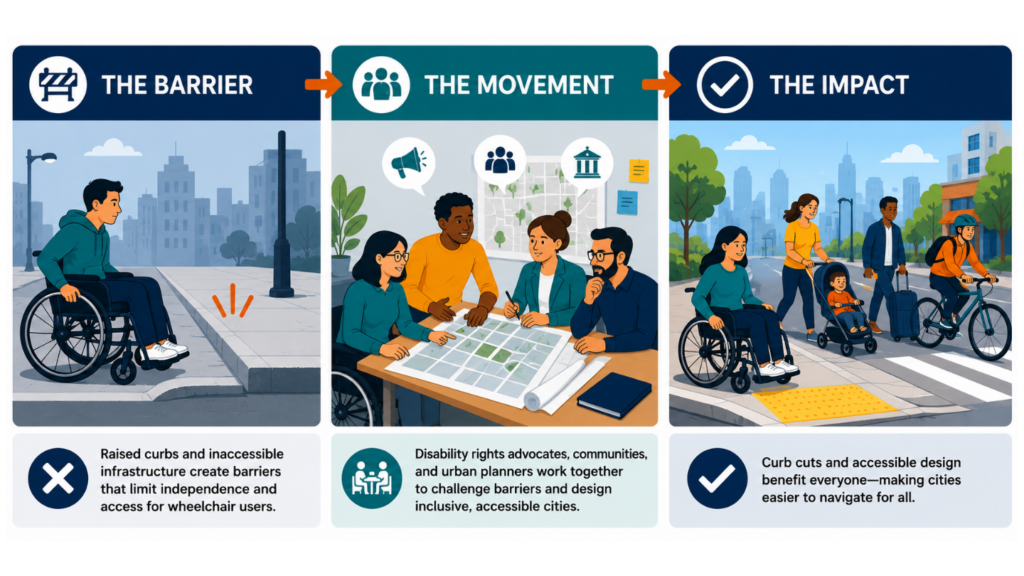
Before curb cuts became common, sidewalks ended in raised concrete edges. For wheelchair users, these weren’t minor inconveniences—they were obstacles that limited independence and access to public spaces. Change did not happen automatically.
Disability rights activists spent years advocating for accessible infrastructure, challenging the assumption that public spaces only needed to work for the majority. Through protests, campaigns, and persistent advocacy, they pushed governments and urban planners to rethink how cities were designed.
Eventually, accessibility regulations made curb cuts a standard feature of urban planning. What began as a disability accommodation quietly transformed the experience of navigating cities for millions of people.
What Is the Curb-Cut Effect?
The Curb-Cut Effect occurs when a solution designed for one group creates benefits for a much larger population. Curb cuts were intended to help wheelchair users, but their usefulness extends far beyond that original purpose.
Today, they help parents in pushing strollers, travellers in pulling their luggage, cyclists crossing intersections, older adults with limited mobility, and many more people. The lesson is simple: inclusive design rarely remains exclusive. Good accessibility often becomes universal convenience.
Once You Notice It, You See It Everywhere
The curb-cut effect is not limited to sidewalks. Once you understand the idea, you begin to see it all around you.
- Closed captions were created for people who are deaf or hard of hearing. Today, they are used by commuters on noisy trains, students learning new languages, and anyone watching videos without sound.
- Voice assistants were designed to make technology more accessible for people who found traditional interfaces difficult to use. Now they help millions of people manage tasks while driving, cooking, or multitasking.
- Predictive text and autocorrect were developed to support people who found typing difficult or time-consuming. Today, they help nearly everyone communicate faster and more efficiently.
- Audiobooks have long been an important resource for people with visual impairments and reading disabilities. Yet they have also become a preferred way for many people to enjoy books while commuting, exercising, or completing everyday tasks.
In each of these cases, what began as an accessibility solution eventually became a convenience embraced by society at large. Accessibility did not benefit only a specific group; it improved the experience for everyone.
While reading about the curb-cut effect, I found myself thinking about something as ordinary as a handrail. Most of us reach for one almost instinctively while navigating a steep staircase, carrying luggage, recovering from a minor injury, or simply trying to keep our balance on a rainy day. Rarely do we stop to consider why it is there. Yet that simple feature exists because someone recognized that not everybody experiences movement in the same way. It was a quiet reminder that many of the conveniences we regard as commonplace are, in fact, rooted in efforts to make the world more accessible.
The Digital Version of the Curb-Cut Effect
The same principle applies online. When websites and applications are designed with accessibility in mind, they become easier for everyone to use.
For example:
- High-contrast text improves readability for users with visual impairments and for people using devices in bright sunlight.
- Clear navigation helps users with cognitive disabilities while making websites easier for first-time visitors.
- Keyboard navigation supports users who cannot use a mouse and also benefits power users who prefer shortcuts.
- Alternative text for images enables screen readers while improving search engine visibility.
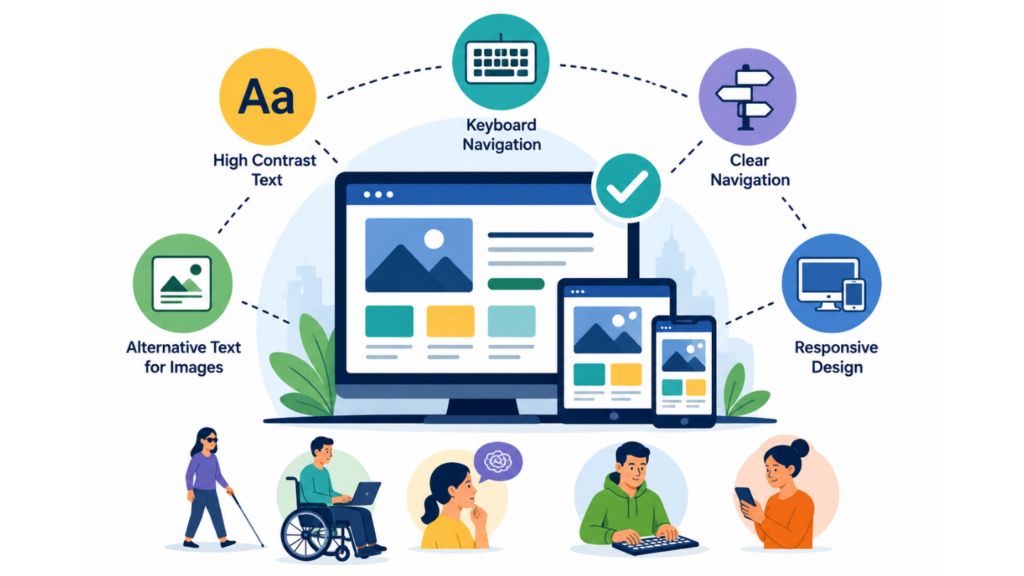
Responsive websites provide another excellent example. A site that works seamlessly across phones, tablets, and desktops is not merely accessible. It delivers a better experience for every visitor. In the digital world, accessibility is not an extra feature. It is a hallmark of good design.
Why Accessibility Is a Smart Investment
Many organisations still view accessibility as a compliance requirement or a box to tick. The curb-cut effect suggests otherwise. Accessibility improves user experience by removing friction. It expands audience reach, strengthens customer trust, and often sparks innovation that benefits everyone.
Some of today’s most widely adopted technologies- from captions to voice interfaces -originated as accessibility solutions. Inclusion is not the opposite of innovation. More often than not, it is where innovation begins.
Designing for the Edges Improves the Centre
The curb cut teaches a lesson far bigger than urban planning. Every design decision either includes or excludes. It either widens participation or narrows it. When we create products, services, and spaces that work for people who face the greatest barriers, we don’t just solve a niche problem; we create better experiences for everyone. That is the enduring brilliance of the curb-cut effect.
Build for those at the margins, and you often end up improving life for the majority.
Related reads
- Common Accessibility Mistakes That Continue to Exclude Users
- Introducing the DigitalA11Y Accessibility Checker
- W3C: Accessibility, Usability, and Inclusion
- History of Curb Cut Effect